Attract
Start with the existing Indeed and social-media job postings rather than requiring a new recruiting channel.
Replacing a manual recruiting process with an automated candidate journey that filtered for fit, kept information connected, and gave the team better visibility.
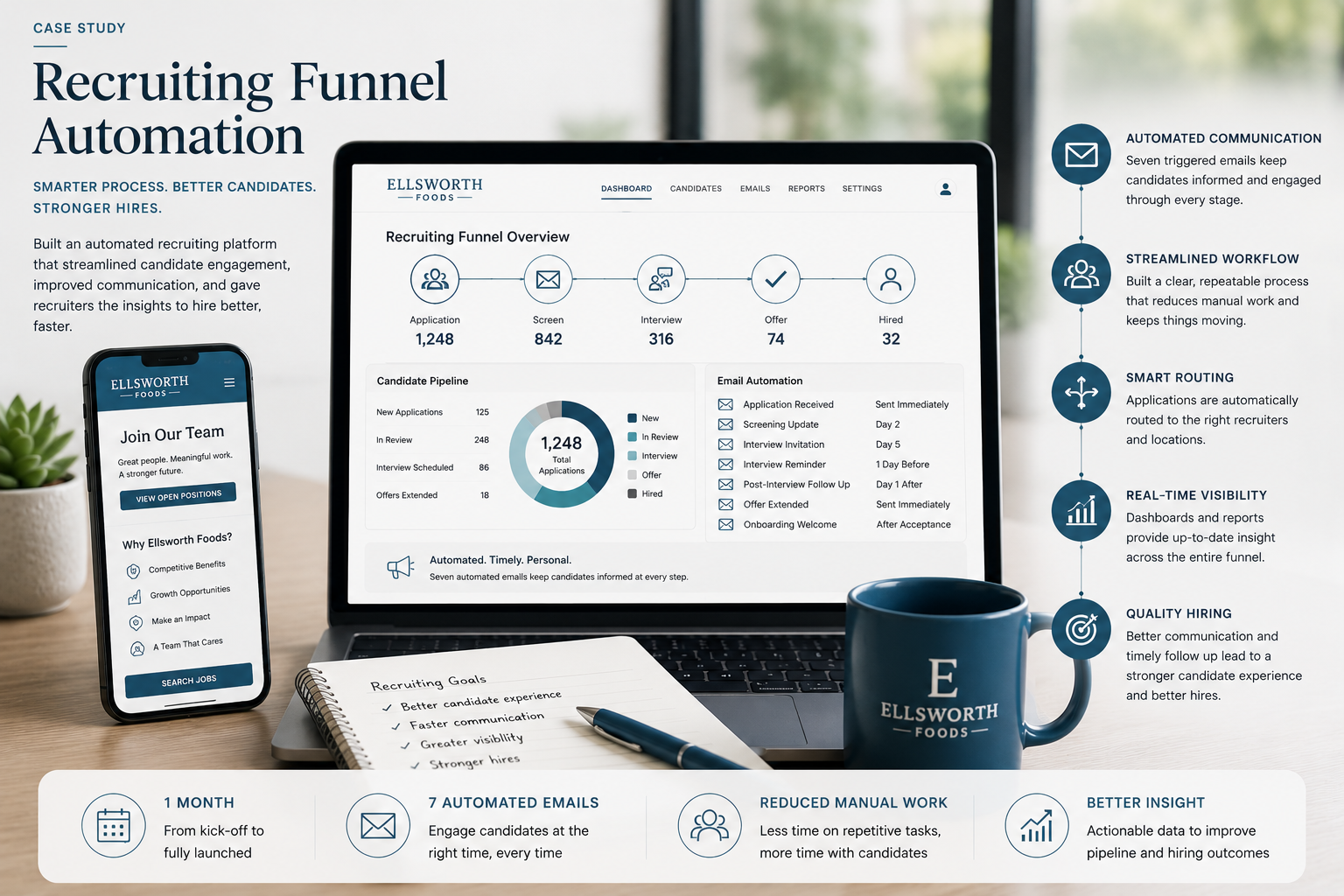
The recruiting process had a clear chokepoint: generating applicants was only the beginning. The Recruiter still had to review applicants, invite candidates, follow up, and manage the flow of information manually.
The objective was to create a more hands-off funnel for identifying viable new sales representatives while keeping the candidate experience connected from the initial job posting through the next stage of the process.
I led the ideation, execution, and data monitoring for the system, working with Recruiting, New Sales, Technology, and Marketing.
My role covered everything except the final key stakeholder, allowing me to shape the workflow from the operational problem through implementation and ongoing visibility.
Start with the existing Indeed and social-media job postings rather than requiring a new recruiting channel.
Automatically guide applicants toward the appropriate landing page and collect the information needed to identify interest and fit.
Generate a candidate key so a candidate could stop and return without creating disconnected information points.
Trigger automated communications from manual actions, defined triggers, and time-based events.
The biggest change wasn't simply that emails became automated. The Recruiter's role changed.
Instead of posting on Indeed, reviewing applicants, inviting candidates, and following up manually, the documented workflow allowed the Recruiter to post the ads and then step out of the repetitive part of the process until the New Sales Director requested that the ads be turned off.
At the same time, the process created greater visibility, automatically looped the appropriate people into the workflow, and provided analytics around what was happening inside the funnel.
The system significantly reduced the time and effort required from the Recruiter while creating a more visible, connected recruiting process.
The source material documents qualitative improvement in recruiter time and effort, process visibility, automatic routing, and analytics. It does not provide a quantified percentage reduction, so none is claimed here.
Automation is most valuable when it removes work nobody should have been doing manually in the first place.
Designing a rapid-response intake system when the business couldn't afford to wait.